
Have you ever planned a nice relaxing camping journey with your friends, set up your tent and fallen asleep, only to be woken up with leaking rain and puddles in the middle of the night?
Ughh nightmare…
No one wants to think about being stranded in a tent in the middle of nowhere (unless wild camping is your thing) whilst it’s pouring down with rain, but this can be a very real reality and it is important that you prepare for the worst.
That’s why, before you even start your camping journey, you need to know whether your tent is actually waterproof enough to survive the coming weather. This becomes doubly important if you’re camping somewhere with frequent or heavy rainfall.
So… how waterproof is your tent?
Let’s break this down properly.
Quick Answer: What Makes a Tent Waterproof?
A good tent needs at least a 2,000mm hydrostatic head (HH) rating for normal conditions, and 3,000–5,000mm for consistent rain, UK weather, or exposed campsites.
But that’s just the starting point. The real question most campers ask is:
“Is my tent waterproof right now?”
Let’s figure that out.
Quick Waterproofness Checklist (Use This Before Your Trip)
You’ll know your tent is waterproof enough if:
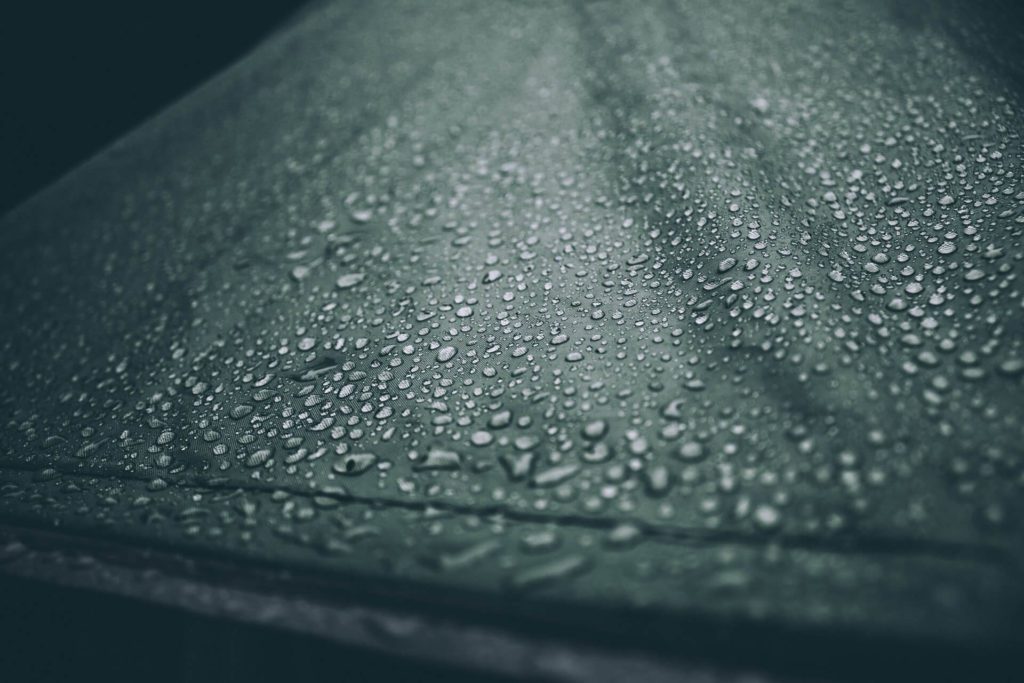
- Water beads and rolls off the flysheet
- The HH rating is 2,000mm+
- Your groundsheet is 3,000mm+
- All seams are taped, sealed or reinforced
- The fabric doesn’t feel dry, chalky or flaky
- You don’t see pinholes or light leaking through stitching
- The inner tent stays dry during mild rainfall
Does your tent fail 2 or more of the above?
Your tent likely needs reproofing or just isn’t suitable for wet conditions. Sorry…
How to Test Your Tent at Home (2–Minute Method)
You don’t need lab gear for this or expensive equipment. Here’s the super quick DIY test:
- Pitch the tent outside.
- Spray it with a hose or watering can for 2–3 minutes.
- Check the usual weak spots:
- seams
- corners
- zips
- roof panel
- Go inside and look for:
- damp spots
- darkening fabric
- dripping or seeping
If anything leaks, then you have a waterproofing issue.
What Exactly Is a Hydrostatic Head Rating (HH)?
Not all tents are made equally, but some are better equipped to deal with rain than others.
The HH rating or hydrostatic head (also known as the water column) rating can be a key deciding factor of a tent’s resistance to rain and its waterproofing capabilities.
The ‘water column test’ is a method of testing the waterproofing of a material. This is done with a lab test where a cylindrical tube with a diameter of 2.5 cm is placed on the material and is then filled up with water. A material’s waterproofing rating will determine the level of water pressure it can handle without leaking through.
For example:
If a tent material can handle 2cm of water before leaking through, then it will be given a rating of 2000mm.
Simple rule: The higher the number, the more waterproof the tent.
Typical Waterproof Ratings by Tent Type
| Tent Type | Average HH Rating | Suitable Conditions |
|---|---|---|
| Festival tents | 1,500mm | Light showers only |
| Budget family tents | 2,000mm | Mild–moderate rain |
| Backpacking tents | 3,000–5,000mm | Regular rain + wind |
| Mountaineering tents | 5,000–10,000mm | Extreme weather |
How Much Hydrostatic Head Do I Need?
Whilst this is great information to know when it comes to tents, the low to mid-range tents will come under the 2,000–3,000mm brackets, whereas some high-quality tents will come under the 3,000–5,000mm brackets.
What does that mean?
It simply means that most tents are not meant to be soaked and put under a huge amount of water pressure. Most are built to get you through some bad weather at least. It is, however, advisable not to go camping if the weather will be very bad unless you are planning to go camping in winter. Although, we doubt that you’d plan to camp in a storm anyway…
How Is the Hydrostatic Head Rating Calculated?
When manufacturers want to convey how waterproof and breathable their tents are, they tend to use 2 key metrics to describe this. These are in millimetres (mm) and grams (g) respectively.
Millimetres (mm)
This metric is usually used to describe how waterproof a piece of fabric is. For example, if a piece of fabric is rated with a HH rating of 10,000mm, it means that if you place this fabric under a tube and fill it with water to a height of 10,000mm, only then would water begin to leak through. The higher this rating, the more waterproof a piece of fabric is going to be.
Grams (g)
This number measures how breathable a piece of fabric is and refers to the grams (g) of water vapour that is able to pass through a square metre (m2) of fabric over 24 hours. As with the mm, the higher this number, the more breathable this fabric is going to be.
How Do Companies Determine Waterproofing Ratings?
Usually, waterproofing tests are conducted by manufacturers or fabric producers in-house or by utilising an external independent lab.
One of the most common tests used to determine waterproof ratings is the static column test (also known as the hydrostatic head test).
There are also variations of waterproof tests, which means the same piece of fabric could have slightly different ratings depending on which test was performed.
When Should You Reproof Your Tent?
If your tent is:
- failing the bead test
- leaking at seams
- feeling rough or flaky
- showing its age
…it’s time to reproof using a spray-on or wash-in waterproofing treatment.
Final Tips to Keep Your Tent Waterproof
- Always pack your tent away dry.
- Avoid harsh detergents that strip coatings.
- Reproof every 12–24 months depending on use.
- Store in a cool, dry place.